
Given that most economies struggle with smart diversification and strategic capability management, identifying untapped opportunities becomes essential for informed policy decisions. Two complementary perspectives reveal where innovation potential lies: where individual economies can strategically expand their capabilities, and where the global innovation system reveals systematic gaps.
A virtuous cycle: stronger ecosystems unlock more opportunities
The first perspective analyzes diversification opportunities by examining the proximity of potential new fields to existing knowledge bases and the complexity required to master them. Not all diversification paths are equally accessible – economies can more easily develop capabilities closely related to current strengths, while distant fields require greater strategic investment. The key question becomes: which new fields offer the optimal combination of accessibility and long-term value creation?
Analyzing how easily economies can access both complex and fast-growing fields reveals important strategic insights about diversification pathways and the underlying capabilities that enable successful expansion.

The relationship between diversification opportunities reveals a fundamental pattern: economies well-positioned to master complex capabilities are generally also best-positioned to enter fast-growing fields (see Figure 3.1). However, notable exceptions emerge: Germany and Japan. These two mature economies can more easily access emerging fast-growing fields than develop entirely new complex capabilities. Portugal exemplifies the typical pattern with high performance in both dimensions, whereas Uganda faces challenges in both areas, highlighting how economies at different development levels face varied difficulties in respect to strategic diversification.

This virtuous cycle has strengthened over time, though unevenly across opportunity types (see Figure 3.2). Since 2001, economies' ability to access fast-growing innovation fields has more than doubled (2.25×) while access to complex fields has grown more modestly (1.60×). This divergence suggests that while diversification opportunities have generally expanded, the gap between accessing emerging markets versus developing sophisticated capabilities has actually widened, potentially reinforcing existing development disparities.
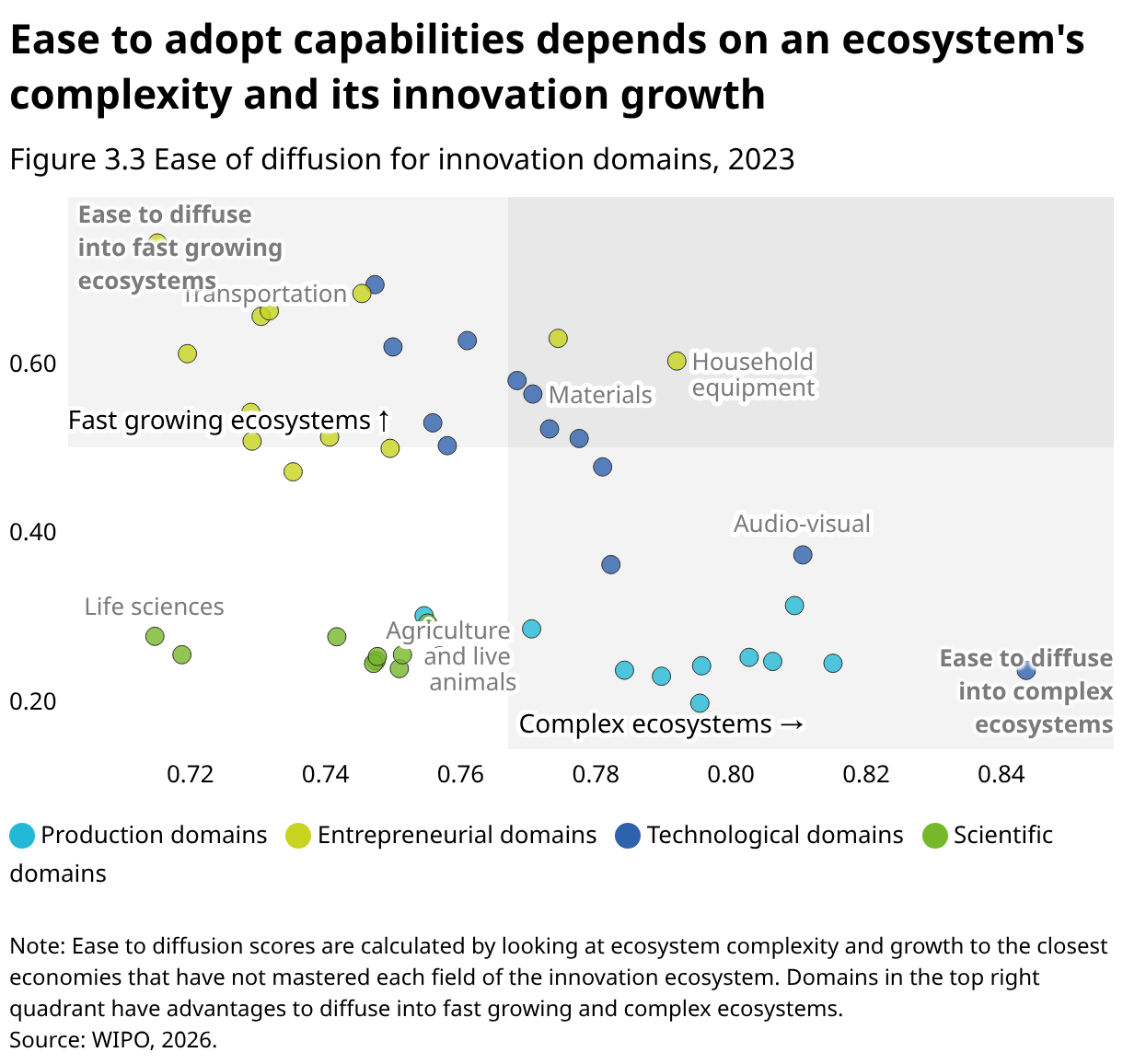
This pattern extends to individual innovation capabilities (see Figure 3.3), revealing distinct strategic pathways for different types of ecosystems.
In general, scientific capabilities emerge as the most accessible entry point, suitable for economies with limited complexity – including basic research, academic publications, and fundamental studies.
Entrepreneurial capabilities are most compatible with low complexity, rapid growth ecosystems.
Many production capabilities tend to require high complexity, but offer modest growth.
Technological capabilities demand sophistication and target economies with fast technological growth.
This segmentation suggests successful diversification strategies should align capability targets with ecosystem development levels (see Table 3.1). Analyses at the innovation ecosystem level reveal how development levels fundamentally shape diversification opportunities. For instance, Portugal's most rewarding opportunities concentrate in advanced technology development – reflecting its existing capabilities. Meanwhile, Afghanistan's opportunities focus on foundational scientific research and basic production activities, representing accessible entry points for building initial innovation capabilities.

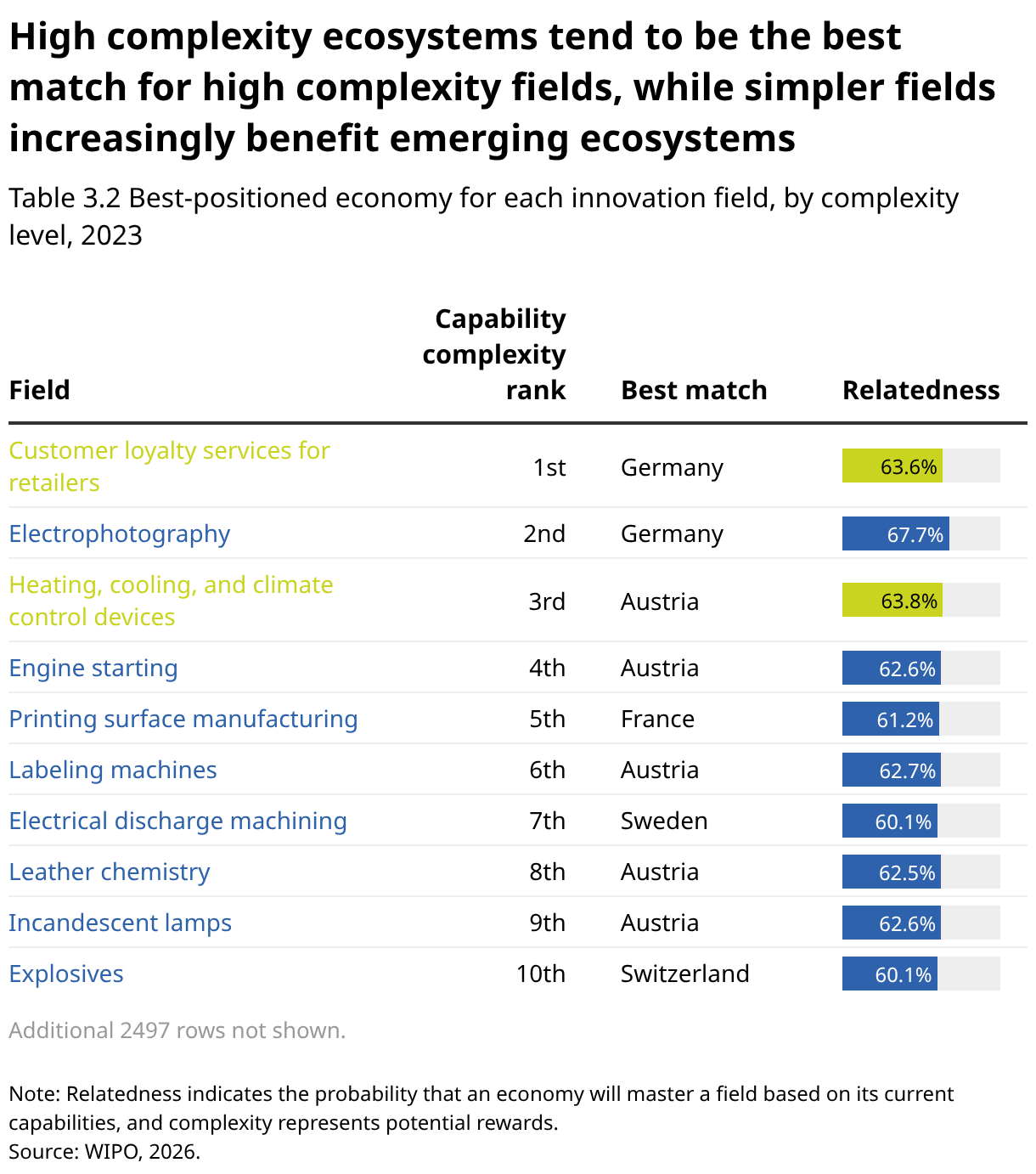
Reversing this perspective – examining which economy is best positioned to develop each specific innovation field – confirms this complexity hierarchy (see Table 3.2). The most sophisticated fields concentrate opportunities among leading innovation hubs, whereas simpler fields increasingly favor less developed economies. This dual perspective provides valuable strategic intelligence both for policymakers planning capability development and companies identifying optimal locations for innovation investment.
This methodology enables a risk–reward framework for innovation policy, recognizing that no unique development path exists. Policymakers should understand the risks of targeting distantly-related fields while using complexity as a guide to potential rewards. However, individual country opportunities represent only part of the innovation landscape – systematic gaps across the global system reveal where expected innovations remain absent despite favorable conditions.
Where innovation potential remains untapped
Innovation ecosystems rarely operate at their full potential. The potential indicator estimates how much more output an economy should produce in any given field based on its performance in related areas. For instance, a country strong in materials science and precision manufacturing should theoretically excel in advanced battery technologies – its existing capabilities provide the foundation. Untapped potential represents the gap between this theoretical capacity and actual performance, revealing where ecosystems fail to fully leverage their knowledge base (see Table 3.3).
However, not all untapped potential deserves attention. Just as smart capability management focuses resources on the most rewarding capabilities, economies should prioritize gaps in high-complexity fields that offer greater returns on investment. Low-complexity, untapped potential may simply reflect strategic choices to concentrate efforts elsewhere rather than true inefficiencies.

The most significant pattern emerges in technological innovation: only 10 percent of economies fulfill their patenting potential based on all their other capabilities. This compares to 27 percent achieving expected trademark volumes, 30 percent meeting export expectations, and 32 percent fulfilling scientific publication potential. This suggests systematic barriers in translating scientific knowledge and manufacturing capacity into patentable innovations – highlighting a critical bottleneck in the global innovation system.
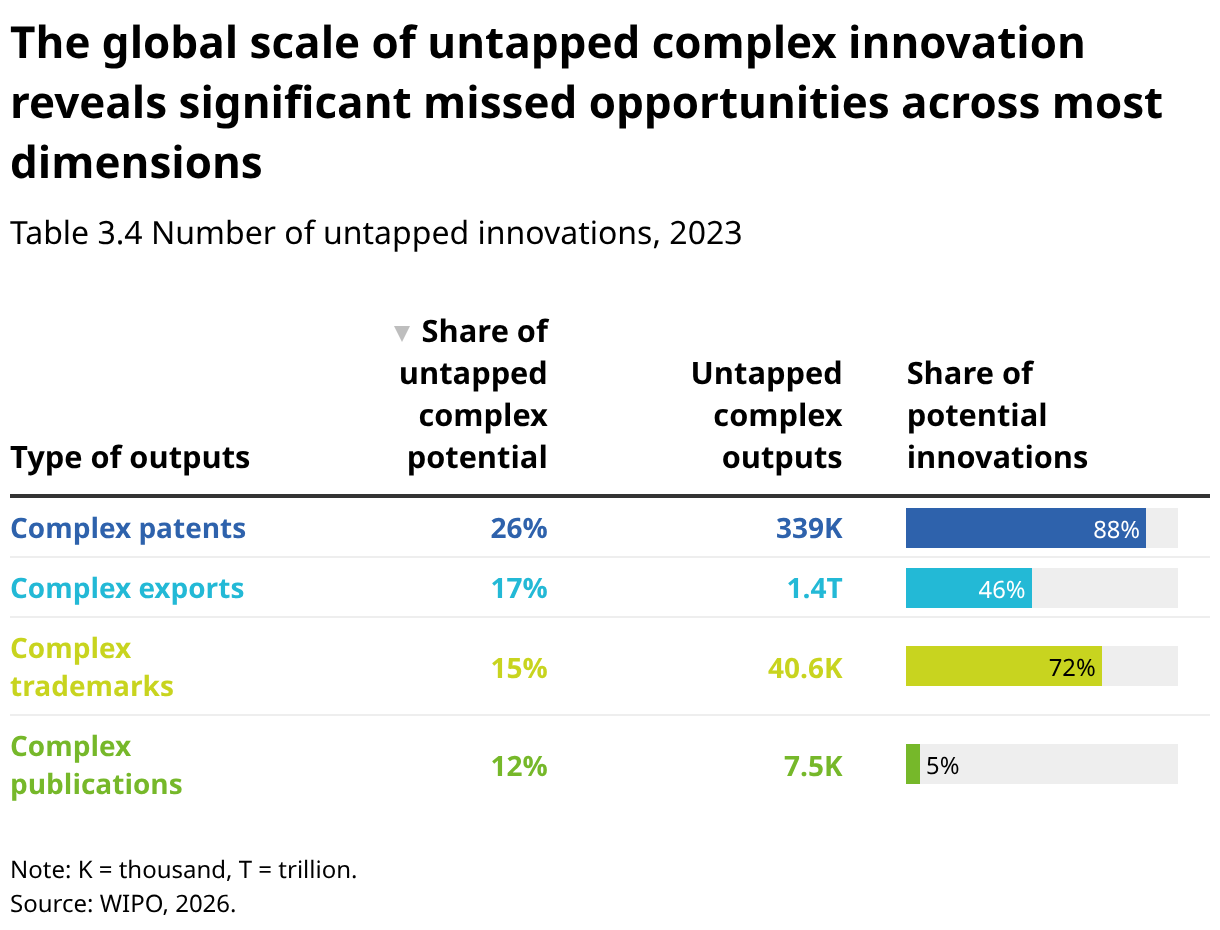
The global scale of untapped innovation reveals significant missed opportunities across most dimensions. Worldwide, innovation ecosystems collectively underperform by approximately 339,000 technologies annually – representing 26 percent of all actual technological innovations – while 40,000 trademarks (15 percent of actual volumes) and 17 percent of export potential remain unrealized (see Table 3.4).
Science presents a markedly different pattern. Only 7,500 complex scientific publications remain untapped globally, representing just 5 percent of all unrealized scientific potential. The remaining 95 percent of untapped scientific publications concentrate in fields that offer limited strategic value to ecosystems.
These patterns indicate that while most innovation dimensions face systematic barriers preventing full utilization of existing capabilities, scientific research demonstrates a more effective alignment between capability development and strategic publication in complex, high-value fields.
Regional patterns in technological potential reveal global disparities in innovation system effectiveness (see Figure 3.4). Only Asia and Northern America consistently exceeded expected patent production, with Northern America's achievement rising dramatically from full potential in 2001 to 60 percent above potential by 2023. Asia has maintained strong over-performance throughout, although declining from 65 percent above potential to 31 percent above. In contrast, Europe operates at just 63 percent of its technological potential, while Oceania achieves only 49 percent. The most concerning trend appears in Africa, where technological potential achievement has declined from what was an already low 34 percent in 2001 to just 19 percent in 2023.

These divergent trends suggest an increasing concentration of effective innovation systems specifically in complex technological capabilities. Northern America has strengthened its ability to convert capabilities into sophisticated patents – indicating an improved commercialization of its most advanced knowledge. Conversely, Asia's decline suggests weakening effectiveness in translating existing capabilities into its most complex technological innovations, despite maintaining overall strength. This pattern reveals that possessing underlying scientific and manufacturing capabilities is insufficient; regions need increasingly sophisticated institutional frameworks to realize their potential in high-complexity technological innovation.

Innovation systems reveal distinct patterns in how different types of capabilities build upon each other to generate potential, patterns that go beyond the underlying distribution of innovation fields (see Figure 3.5). While production capabilities represent the largest category (34 percent of all fields) and science the second largest (25 percent), regional specialization patterns show a marked deviation from these baseline proportions.
Latin America and the Caribbean exemplifies a science and production-driven system, where scientific research contributes 26–36 percent of potential across innovation dimensions, complemented by strong production capabilities (43–53 percent). This suggests economies that excel at fundamental research and manufacturing, but struggle to translate these into entrepreneurial ventures and technological breakthroughs.
Northern America demonstrates the most balanced innovation ecosystem, with technology capabilities contributing strongly (32–37 percent of potential) while maintaining significant contributions from all other dimensions. Each innovation type draws more evenly from different sources, suggesting sophisticated knowledge flows between activities.
In contrast, Africa shows a heavy dependence on scientific research as a driver for untapping potential (50–70 percent across most dimensions). This, added to a low diversity in all other dimensions, points to relatively strong academic foundations, but weaker commercialization pathways. Europe and Oceania rely more heavily on entrepreneurial capabilities to drive potential, while East Asia presents a relatively balanced profile with strong contributions from production capabilities alongside other dimensions.

Examining untapped potential by innovation domain reveals a clear complexity hierarchy across regions (see Table 3.5). Europe dominates missed opportunities in the most sophisticated technological fields – holding 87–90 percent of untapped potential in advanced domains like manufacturing systems, electronics, physics instruments, and chemistry. This concentration reflects Europe's strong scientific and production foundations that remain underutilized for complex technological innovation.
As complexity levels decrease, untapped potential shifts toward other regions. East Asia emerges prominently in mid-complexity entrepreneurial and production domains, particularly in chemicals, research services, and manufacturing sectors. Africa's untapped potential concentrates in lower-complexity areas like agriculture, raw materials, and basic production activities, consistent with its development level and existing capabilities.
The geographical distribution of missed opportunities suggests that targeted interventions should focus on Europe's technological translation gaps, Asia's entrepreneurial commercialization challenges, and Africa's foundational capability building. This pattern reinforces the finding that untapped potential varies systematically in respect to both regional development levels and innovation complexity, providing clear strategic guidance for where different types of policy interventions might yield the highest returns.
Opportunities as a road map for strategic innovation policy
These two complementary perspectives – diversification opportunities and untapped potential – provide a comprehensive framework for identifying where innovation investments can yield the highest returns. Evidence reveals clear strategic pathways: economies should pursue diversification opportunities aligned with their development levels while addressing systematic gaps that prevent them from realizing their full innovation potential.
The patterns are remarkably consistent across both analyses. Advanced economies like those in Europe possess strong foundational capabilities, but struggle with technological translation, suggesting the need for improved commercialization infrastructure and technology transfer mechanisms. Emerging economies in Asia show balanced capabilities, but face entrepreneurial commercialization challenges, pointing toward policy interventions that strengthen market linkages and business development support. Developing economies, particularly in Africa, should focus on foundational capability building in accessible scientific and production domains while gradually building toward more complex activities.
Perhaps most importantly, these findings reveal that innovation policy cannot rely on one-size-fits-all approaches. The systematic nature both of diversification constraints and untapped potential suggests that successful strategies must be tailored to regional development levels, existing capability portfolios, and institutional contexts. Countries and regions that align innovation investments with these evidence-based insights are positioned to break out of traditional development constraints and accelerate a transition toward knowledge-based competitiveness.